Leak Detection Redwood Shores
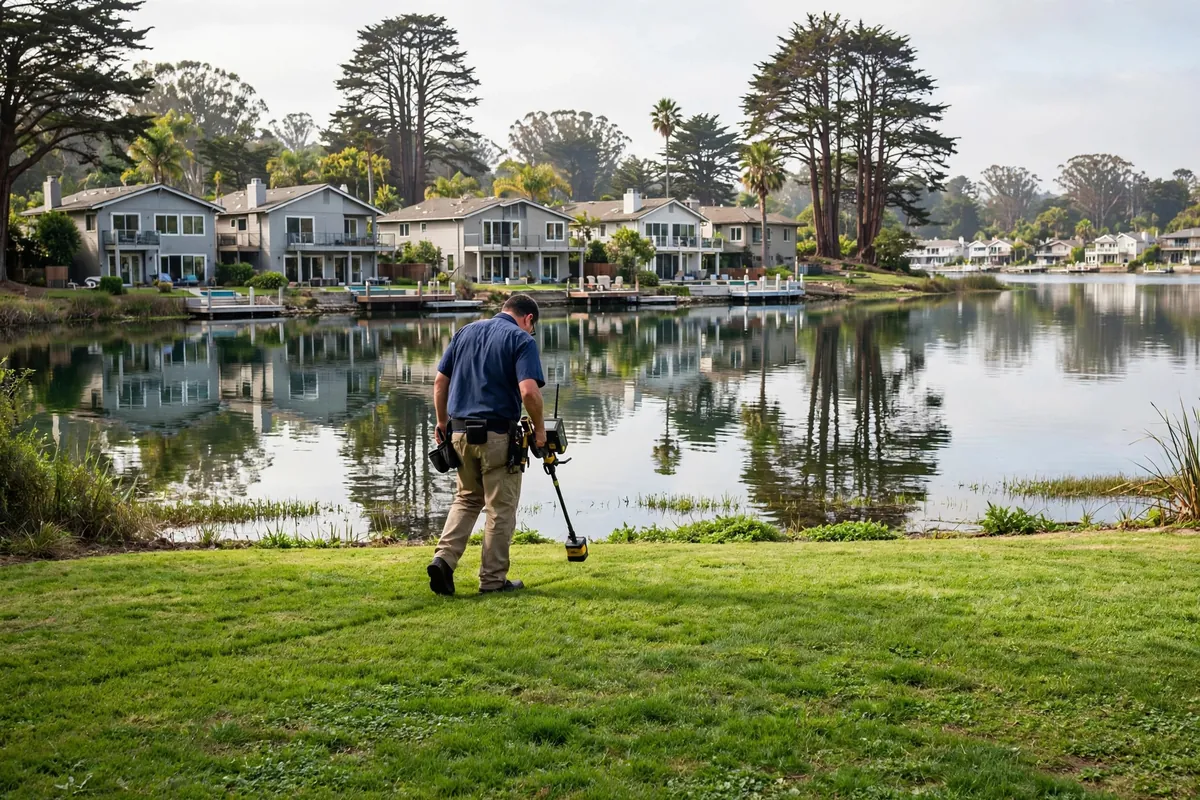
Most leak detection Redwood Shores calls start with a water bill that makes no sense — because out here, a leak rarely shows itself. This waterfront community was built on former marsh and bay floor, and the soft, saturated ground swallows leaking water before it ever reaches the surface. Leak Detection Pros locates slab and underground leaks across the Shores with acoustic and thermal equipment, so the first hole anyone digs is the right one, in the right spot.
Newer Homes, Bay-Side Ground
Redwood Shores homes are among the newest in the city, but the ground beneath them is old bay floor — and that combination shapes every leak here.
The Shores is a planned waterfront community of lagoons, canals and landscaped streets, built decades after the postwar tracts on the city's older streets. A large share of its homes sit on slab foundations rather than raised perimeters, which moves the plumbing story under the concrete: supply lines run beneath the slab, and when one fails, the water has nowhere visible to go. The city's own sea level rise assessment describes this shoreline as former marsh and bay floor with soft, saturated soils — ground that also shifts and settles over time, working on buried pipes and their joints season after season.
That saturated soil is the real detection challenge. In drier ground a buried leak eventually makes a soggy patch. Here it can drain silently into the bay mud for months, surfacing only as a meter that creeps and a bill that climbs. It is also why guessing is expensive in the Shores: opening a slab or a landscaped yard in the wrong place costs real money, twice. Electronic pinpointing — isolate, pressure test, trace, listen, confirm with thermal — exists for exactly this kind of ground.
The Meter Tells the Truth First
Out here the earliest leak detector is your water meter and the city's My Water portal. If the low-flow indicator moves with everything off — or the portal shows water running at 3 a.m. — the leak is real even if the yard looks dry. That is the moment to call, before the bill becomes a second mortgage payment.
Leak Problems We See Most in Redwood Shores
Slab lines, buried yard runs and irrigation — the Shores' leak pattern follows its slabs and its saturated soil.
- Hot-water slab leaks — a warm patch of floor, a heater that cycles too often, a bill climbing month over month
- Cold-water slab leaks — quieter: no warm spot, just meter movement and dampness creeping at a wall base
- Underground service line leaks — the meter-to-house run losing water straight into soft soil, with no surface sign
- Joint failures from settling ground — bay-side soils shift, and buried pipe joints take the stress
- Irrigation line breaks — landscaping water escaping underground, hidden by already-wet ground
- Pressure-related wear — high incoming pressure quietly shortening the life of every fitting in the house
The thread through all of them: by the time a Shores leak is visible, it has usually been running a long while. The cheap moment to find it is when the only evidence is the meter.
Two ground conditions make the Shores different from the rest of the city. The first is that saturated soil hides leaks. The second is that the same soft ground moves. The city's own sea level rise assessment ties this shoreline to subsidence and liquefaction susceptibility, and even without an earthquake, season after season of settling bay mud works on buried pipes and their joints. That is why a Shores home can hold pressure one year and fail at a joint the next — and why the report we leave behind notes the condition of the whole run, not only the leak we came for.
The slab itself deserves a mention, too. Some Shores homes were built on post-tension slabs, with steel cables tensioned inside the concrete. Cutting into one blindly can snap a cable, which turns a plumbing repair into a structural problem — a fear homeowners in slab forums raise for good reason. The pinpoint-first process exists for exactly this situation: the leak is located and marked electronically, so any opening is small, deliberate, and placed with the slab's construction in mind.
Services We Run in Redwood Shores
The three calls that cover nearly every leak on the Shores:
Slab Leak Detection
Under-slab leaks located electronically and marked on the floor before any concrete is opened.
Learn more →Water Leak Detection
Buried service lines, wall leaks and mystery meter movement, traced across the whole property.
Learn more →Irrigation Leak Repair
Broken sprinkler lines and stuck valves losing water into ground that is already wet enough to hide it.
Learn more →Redwood Shores ZIP Code: 94065
Redwood Shores has its own ZIP code — 94065 — and it is fully inside our service area, along with the rest of the city.
New to how a detection visit works? Our Redwood City leak detection homepage walks through the full process, from the first meter check to the written report. More areas on our routes:
Three Leak Scenarios We Run Into on the Shores
Different streets, same soft ground. These are the calls that repeat here, and how each one actually gets solved.
The warm patch by the lagoon
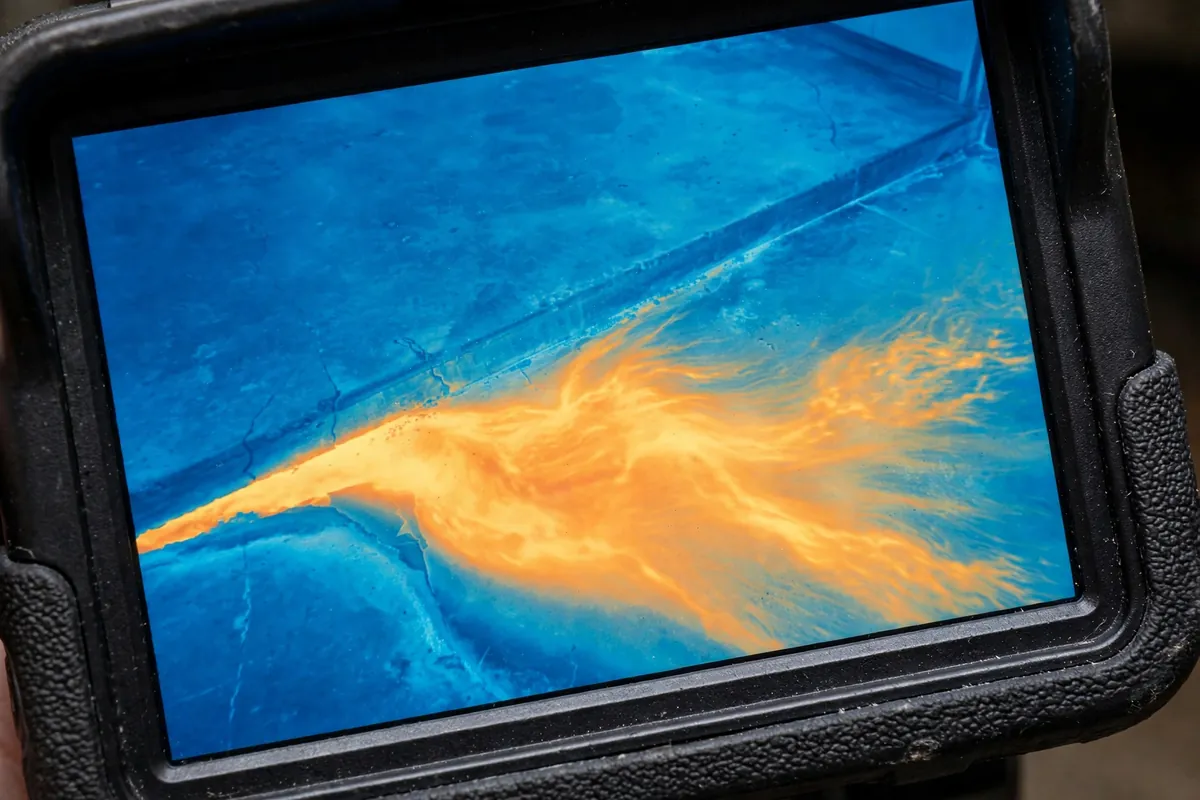
A homeowner notices one section of floor that always feels warm underfoot, and a water heater that seems to run more than it should. The thermal camera shows why: a warm plume spreading through the slab from a hot-water line that has opened underneath. Because the leak is located electronically first, the repair conversation starts with a mark on the floor and real choices — a spot repair through a small opening, typically $1,500–$3,500, or a reroute that abandons the under-slab run entirely at $2,000–$4,500. Nobody touches the concrete until the spot is proven.
The yard that never dries
On saturated ground, a soggy lawn proves nothing by itself — the whole neighborhood drains slowly. The tell is the pattern in the My Water portal: usage that never drops to zero, hour after hour, including the middle of the night. That signature points away from irrigation and toward the buried service line, losing water straight into the soil between the meter and the house. We trace that run electronically and listen along it, so the single dig that follows lands on the pipe instead of somewhere in the general neighborhood of wet.
The irrigation break nobody could see
A broken sprinkler line in already-wet ground is the perfect invisible leak: no puddle stands out, and the lawn just looks healthy. It shows up as a controller that seems to run longer than it should, or a usage spike that matches watering days. Isolating the irrigation zone by zone finds the break — a cracked lateral, a valve passing water when it should be shut — and the fix stays in the landscaping instead of becoming an excavation.
Notice what all three have in common: the evidence was a pattern — warmth, meter movement, an hourly usage shape — long before it was a puddle. On bay-side soil, pattern-reading is the skill. The equipment confirms what the pattern suggests, the mark goes down, and the repair stays as small as the leak allows.
Redwood Shores Leak Questions
Why do leaks in Redwood Shores hide for so long?
The Shores was built on former marsh and bay floor, and the ground here stays soft and saturated. A buried leak drains away into that soil instead of bubbling up to the surface, so the first real symptom is usually the water bill — or a meter that moves when nothing is running — rather than a puddle you can see.
Is a warm spot on the floor really a slab leak?
Often, yes. A warm patch usually means a hot-water line is leaking under the slab and heating the concrete above it. A cold-water slab leak is quieter — it shows up as a rising bill, a faint running-water sound, or dampness at the base of a wall. Acoustic equipment and a thermal camera confirm which one you have before anything is opened.
Will finding the leak tear up my yard or floors?
No. We isolate the line, pressure test it, trace its run electronically, then pinpoint the leak with acoustic listening gear and thermal imaging. The spot gets marked first. Any opening for the repair is small and targeted — nobody digs up a yard or cuts a floor on a hunch.
What does leak locating cost in Redwood Shores?
A basic leak inspection typically runs $100–$300, electronic acoustic detection $300–$800, and slab or underground locating $500–$1,200, depending on the home and how buried the leak is. You get the range before work starts, and detection is always quoted separately from the repair.
If it is a slab leak, do I spot repair, reroute, or repipe?
It depends on the pipe's condition. A single failure in otherwise sound pipe suits a spot repair, typically $1,500–$3,500. A line that has failed before, or is corroded along its run, is usually better rerouted overhead at $2,000–$4,500. Repiping enters the picture when leaks keep appearing in different places. We show you all three ranges and the reasoning before you choose.
What is a post-tension slab, and why does it matter for my repair?
A post-tension slab has steel cables stretched tight inside the concrete to strengthen it. If a repair crew cuts or drills into the slab without knowing where the cables run, a snapped cable can whip and seriously damage the slab — and fixing that is a structural job, not a plumbing one. It is one more reason the leak gets pinpointed electronically first, so any opening is small and deliberately placed.
Can high water pressure cause leaks in my home?
Yes, over time. Pressure that stays too high works on every fitting, valve and fixture in the house, and it usually shortens the life of water heaters and toilet fill valves first. During a detection visit we can check the static pressure at an outside tap. If it is running high, a pressure-regulating valve is the standard correction, and it protects everything downstream of it.
Will insurance cover a slab leak repair in my home?
Often the resulting water damage and the cost of opening the slab and restoring it afterward are covered, while the pipe repair itself usually is not. A leak that ran undetected for months may also be treated as gradual damage and denied. Every policy differs. Our written report documents where the leak is and what it damaged, which is what an adjuster needs to evaluate the claim.
A Shores Leak Will Not Announce Itself. The Meter Already Has.
If your bill is climbing and the yard looks innocent, trust the meter. One visit pinpoints the leak — under the slab, in the yard run or in the irrigation — and prices the fix in ranges, in writing, before you decide anything.
Call (650) 632-9185 Request a Quote