Tree Roots in Your Sewer Line: Redwood City's Quiet Underground Problem
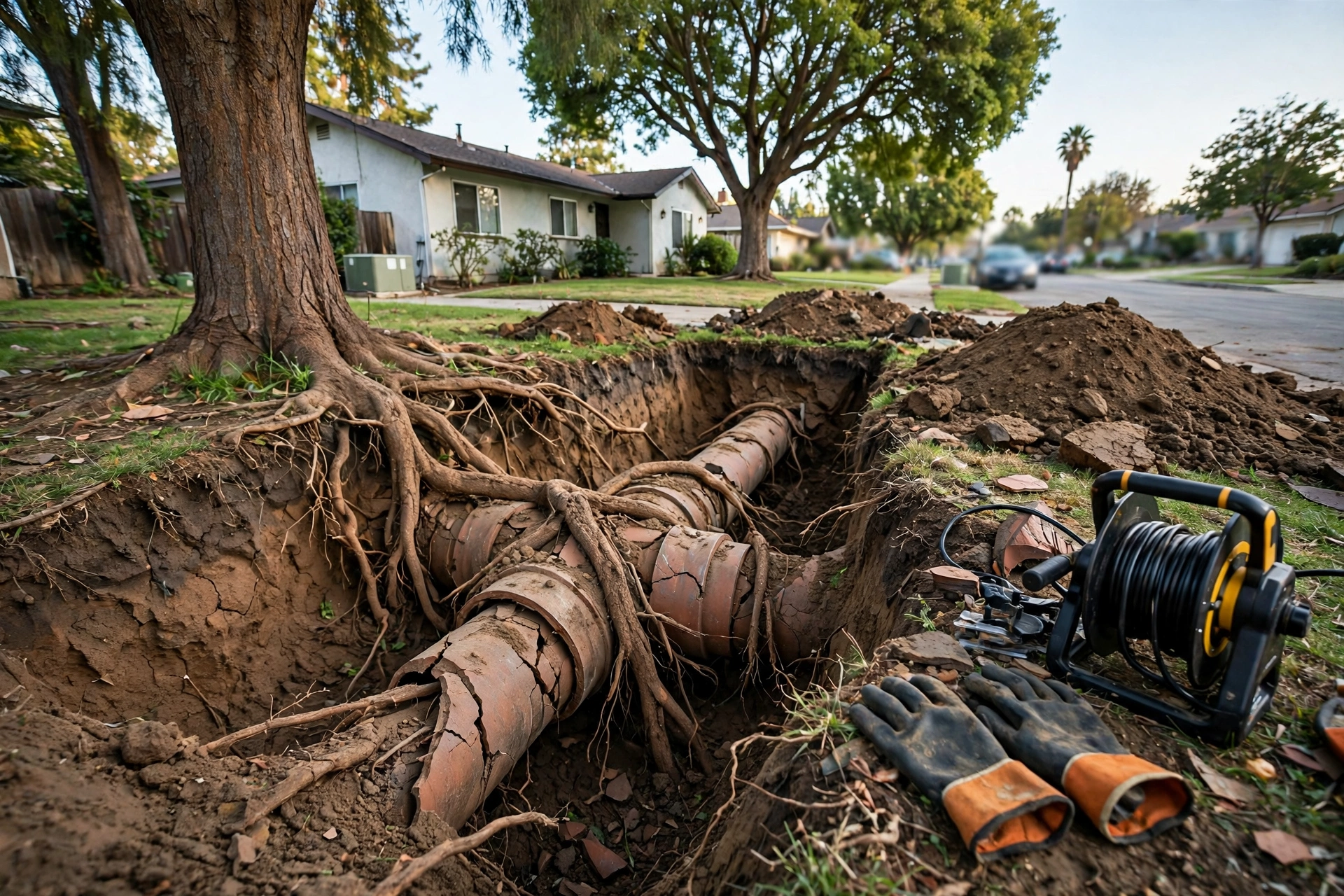
The sewer line under a Redwood City front yard lives in the same soil as the trees that shade it — and roots are patient. A root tip finds a hairline crack or a loose joint in an old clay lateral, follows the moisture and nutrients inside, and spends years thickening into a net that catches everything the house sends down. By the time the drains slow, the roots usually own a section of the pipe.
We run more root calls in Redwood City than almost any other sewer problem, and the pattern is consistent: an older home, a mature street tree or a big front-yard planting, and a backup that keeps coming back a few months after every cleaning. This guide covers how roots get in, the signs that separate a root problem from an ordinary clog, what a camera shows us, and the honest options — from cutting roots on a schedule to replacing the section — once we can see inside the line with our sewer leak detection camera work.
How Roots Get Into a Sewer Line
A sewer lateral is a pipe full of water vapor and nutrients running through dry soil — to a root system, it reads like a spring. Roots do not break into sound pipe. They enter where the pipe is already open: the joints between clay pipe sections, a crack from decades of soil movement, a connection that was never perfectly sealed. Redwood City's older neighborhoods — Mount Carmel, Stambaugh Heller, the streets around Downtown — still run plenty of clay laterals installed generations before PVC, and clay is jointed every few feet. Every joint is a door.
Once a root hair is inside, the pipe feeds it. Roots grow toward the flow, branch, and mat together. The mat catches toilet paper, grease, and wipes, and the partial blockage slows the line further, which deposits more material, which feeds more root growth. It is a problem that compounds — which is why a line that needed cleaning every few years starts needing it every few months.
Roots or Just a Clog? The Signs That Separate Them
An ordinary clog is an event: something went down that should not have, the line stopped, a cleaning clears it and the story ends. Roots tell a longer story. Gurgling that starts in the lowest fixtures in the house. A downstairs shower or floor drain that backs up first. Backups that return on a rhythm — every spring, every few months — no matter how well the line was cleaned. Slow drainage in several fixtures at once, not just one sink. And the seasonal tell: problems that flare in spring and after wet winters, when root growth and groundwater both peak.
Our drain cleaning page makes the same point from the other side: a clog that keeps its appointments is telling you something about the pipe, not about what went down it. When a Redwood City homeowner tells us the line has been cleaned twice this year, we stop talking about cleaning and start talking about a camera.
What the Camera Shows — and Why Guessing Wastes Money
A sewer camera answers the three questions that decide the repair: where are the roots, how much of the line is affected, and what shape is the pipe itself in? Fine root hairs at one joint are a maintenance problem. A root mass filling half the pipe across three joints is a replacement conversation. And sometimes the camera finds that roots are the symptom, not the disease — a cracked or offset section that roots merely moved into.
We run the camera from the cleanout and narrate what it sees while you watch, the same approach laid out in our sewer camera inspection guide. You get the footage and a marked location on the surface above the problem spot. That evidence is what keeps the next decision honest: nobody has to sell you a full lateral replacement for a one-joint root problem, and nobody can talk you into a third cleaning for a pipe that is coming apart.
Your Options Once Roots Are Confirmed
Cut and maintain. A cable machine with a root-cutting head, or a high-pressure jet, clears the mass and restores flow. The roots grow back — typically the line buys a year or a few years per cutting, depending on the tree and the joint. For a sound pipe with one entry point, scheduled cutting is a legitimate, economical strategy, and we will say so.
Repair the entry point. If the roots come through one cracked joint or one short damaged section, replacing that section — or lining it where conditions suit — closes the door instead of trimming what walks through it. This is the middle path most root problems actually call for.
Replace the lateral. When the camera shows roots at every joint, cracks along the run, or a belly holding water, the line is done and money spent maintaining it is money delayed, not saved. A full replacement is the biggest option and sometimes the only honest one.
Which of these fits your line depends on what the camera saw — anyone quoting you a fix before looking inside the pipe is guessing with your money. The detection side of the visit, and what it costs, is covered in our leak detection cost guide.
Who Calls Us About Roots
Owners of older Redwood City homes with big street trees — the classic combination. Sellers whose pre-sale camera scope found roots and buyers deciding what the finding is worth; our pre-purchase leak detection visits run into this constantly during escrow. And homeowners who have paid for the same cleaning one time too many and want to see the inside of their own pipe before paying for anything else.
We are based at 280 Convention Way and have scoped Redwood City laterals since 2018. The camera does not care whose tree it is or who quoted you last — it just shows the line. Start there, and the right fix usually picks itself. Everything else we do starts from our local leak detection specialist in Redwood City CA homepage.
Tree Root Questions, Answered
How do tree roots get into a sewer line that is buried and sealed?
They enter where the pipe is already open — the joints between clay sections, a hairline crack, a tired connection. A root hair follows the moisture vapor escaping those openings, gets inside, and the line feeds it. Sound pipe does not get invaded; older jointed clay laterals, which Redwood City still has in large numbers, offer a door every few feet.
My drain was cleaned three months ago and it is backing up again. Is that roots?
It is the classic root pattern. Cleaning cuts the mass back but leaves the root system and the entry point alive, so the mat regrows — and each regrowth tends to come faster. A camera inspection shows how much of the line is involved and whether the pipe itself is cracked, which decides between scheduled cutting and an actual repair.
Will cutting the roots damage my pipe or the tree?
A cutting head sized to the pipe clears roots without harming sound pipe, and removing roots from inside a sewer line does not meaningfully harm the tree — the root system is vast compared to the few roots using the pipe. What cutting cannot do is close the opening they came through, which is why the camera findings, not the cutting, decide the long-term plan.
Backups Keep Coming Back? See Inside the Line.
If the same drain keeps clogging on a schedule, the pipe is telling you something a cleaning cannot fix. One camera visit shows the roots, marks the spot, and prices the real options in ranges, in writing.
Call (650) 632-9185 Request a Quote